A telephone caller asked if I could look at a long case clock. When winding it the strike mechanism weight had fallen to the bottom of the case.
I suspected a broken gut or chain, but when I had a look at the clock the gut was intact. However, the click spring on the strike barrel appeared to have broken and was no longer holding the click in place – that would explain why the weight had fallen. I initially hoped to be able to replace the click spring without taking the clock away, but there was limited clearance between the great wheel, barrel and a pillar and I couldn’t reach it properly. So hood, weights and pendulum were taken off, and the mechanism was free to lift out.
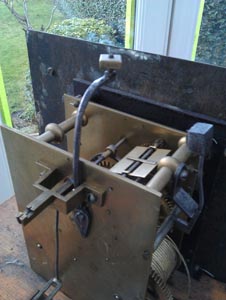

The first view above is the mechanism from the rear, the second is the dial with the hands removed. It’s very soon apparent that the clock is a marriage of dial and mechanism; between the front clock plate and the dial is a cast iron false plate, normally associated with painted dials, whereas this dial is brass. A closer view shows how the brass dial has been modified to fit the mechanism; the winding holes and date slot have been cut through the maker’s name, and under the “r” of Tiverton can be seen the pivot for the date wheel.

The next view is of the false plate from the mechanism side.


A close-up of one corner shows that the false plate is broken into several pieces and has been plated and riveted. My guess would be that the clock has fallen over at some time and the original painted dial was smashed. The false plate was repaired and a brass dial was modified to fit. A quick search of the literature suggested that several features of the mechanism would date the clock to around 1785, so I guess it’s showing its age and history.